
We see this scenario play out more often than we’d like: a manufacturer signs with a 3PL based primarily on competitive pricing, confident they’ve secured an excellent deal. For the first month or two, operations proceed smoothly. Then the problems begin surfacing. A critical delivery arrives three days late to a major retailer. Inventory counts consistently fail to reconcile. The warehouse management system proves incompatible with modern ERP platforms, forcing manual workarounds that slow everything down.
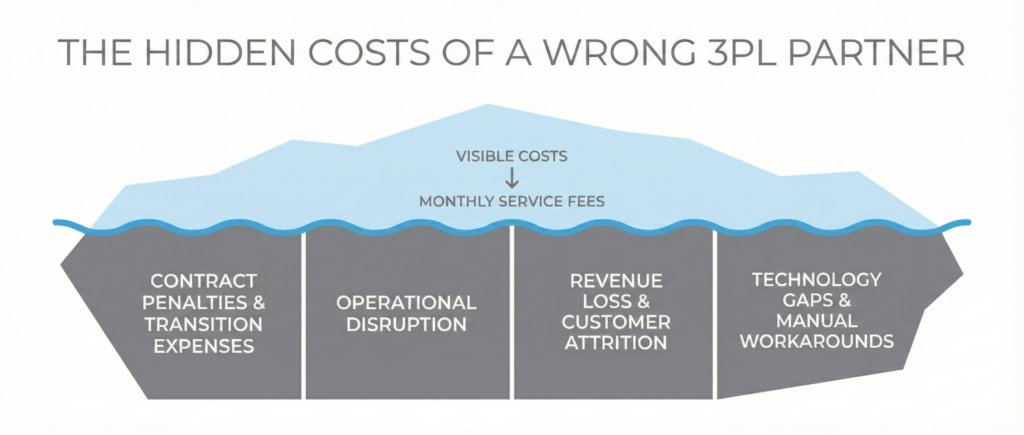
What follows tends to be expensive in ways most manufacturers don’t anticipate when evaluating providers. Monthly invoices represent only the visible costs. The real financial impact of a mismatched logistics partnership emerges gradually, accumulating across operations until addressing the problem becomes unavoidable.
Understanding the Full Cost Picture
When evaluating the true cost of selecting an incompatible logistics partner, the analysis extends well beyond monthly service statements. These hidden expenses accumulate over weeks and months, compounding until they threaten operational stability and profitability.
- Contract termination penalties that can reach tens of thousands of dollars
- Operational disruption during provider transitions that diverts resources from growth initiatives
- Revenue loss from delivery failures that erode customer confidence and market position
- Technology integration failures requiring expensive manual workarounds
- Brand reputation damage that proves difficult to repair once delivery reliability comes into question
1. Contract Penalties and Transition Expenses Multiply Quickly
Most 3PL agreements include early termination provisions designed to recoup the provider’s onboarding investment in system configuration, staff training, and account setup. When manufacturers need to exit these contracts prematurely, termination fees typically range from several hundred to several thousand dollars, scaling with contract duration and service complexity.
The termination fee represents just the first line item in a much larger expense column. Inventory must be physically relocated, which generates freight costs for interstate or international transfers. Transition periods often require overlapping facility payments because inventory cannot transfer instantaneously across geographic distances. Legal expenses may emerge if contract interpretation becomes disputed. Consider a beverage manufacturer transitioning from West Coast operations to strengthen East Coast market coverage: $15,000 in termination penalties, $8,000 for cross-country freight, and $12,000 in dual facility costs during a 60-day handover period. The visible switching expense reaches $35,000 before accounting for productivity losses or operational disruption.
2. Operational Disruption Diverts Resources From Growth
Switching logistics providers requires coordination across virtually every business function. Sales teams need revised delivery timeframes for customer communications. Finance reconciles final invoices while establishing new payment terms and vendor relationships. Operations coordinates physical inventory counts, manages SKU mapping in unfamiliar systems, and troubleshoots integration challenges that invariably surface during implementations.
The prevalence of these transitions reveals underlying market friction: approximately 37% of retailers plan to switch or recruit new 3PL partners annually. This figure suggests widespread challenges in achieving sustainable logistics partnerships, with manufacturers repeatedly cycling through providers in search of adequate operational fit.
The productivity impact extends well beyond direct transition activities. Staff members spend weeks mastering new platforms and procedures. Customer service fields inquiries about shipment delays. Operations manages the exceptions and edge cases that emerge when processes change. For a manufacturer with 50 employees, a conservative estimate of 400 collective transition hours represents approximately $20,000 in diverted labor costs. These hours could otherwise advance product development, market expansion, or customer relationship building instead of maintaining operational continuity during a preventable transition.
3. Service Failures Trigger Revenue Loss and Customer Attrition
Persistent delivery problems extend beyond customer frustration to direct financial consequences. Retailers impose chargebacks for missed delivery windows, typically ranging from $150 to $500 per incident. Consumer brands selling through Amazon face stockout penalties and loss of Buy Box positioning that can take weeks to recover. Each service failure compounds the damage to business relationships that may have taken years to establish.
Consider a specialty food company partnering with a Southeast regional 3PL struggling to manage temperature-controlled inventory effectively. The provider’s outdated warehouse management system cannot properly execute first-in-first-out rotation for products with 90-day shelf lives. Retailers consequently receive shipments with only 45 days remaining before expiration, triggering immediate rejections. Over six months, the manufacturer absorbs $180,000 in rejected inventory, pays $42,000 in retailer penalties, and ultimately loses distribution agreements with three regional grocery chains representing $850,000 in annual revenue. The financial impact extends far beyond the immediate losses as the manufacturer works to rebuild credibility with remaining accounts.
The cascading effect of operational failures creates lasting market damage. Each lost retail relationship makes the business less attractive to remaining customers, who begin questioning the manufacturer’s operational capabilities regardless of where the actual problems originated.
4. Technology Gaps Generate Costly Manual Interventions
Contemporary supply chain management depends on real-time data visibility and automated system integration. When a 3PL’s warehouse management system cannot communicate effectively with enterprise resource planning platforms, operations default to manual processes that introduce errors and create delays. EDI connections fail, requiring manual order entry. API limitations prevent automated inventory updates. The cumulative effect degrades operational efficiency and customer service quality.
A manufacturer six months into a contract discovers their partner’s legacy WMS cannot deliver the inventory accuracy required for just-in-time fulfillment strategies. System integration proves impossible despite initial assurances, forcing the manufacturer to hire two additional operations coordinators at $55,000 annually to manually reconcile inventory daily and coordinate shipments through phone and email communication. Over a three-year period, this workaround costs $330,000 in additional labor expenditure alone, without accounting for opportunity costs from slower order processing and diminished responsiveness to customer requirements.
5. Strategic Partner Selection Prevents Costly Mismatches
The costs outlined above share a common origin: insufficient due diligence during the partner selection process. Manufacturers often prioritize pricing over operational compatibility, selecting the lowest bid without thoroughly evaluating capability alignment, technology infrastructure, and long-term scalability.
Effective partner evaluation begins with comprehensive questions about operational capabilities and limitations. Does the provider have demonstrated experience with your product category, whether that involves temperature-controlled food and beverage storage, fragile goods handling, or products subject to regulatory requirements? Can their technology integrate with your existing systems without requiring extensive workarounds? Do they operate in the geographic markets essential to your distribution strategy? These fundamental questions prevent mismatches that generate expensive corrections later.
Associated Warehouses addresses this challenge by connecting manufacturers with vetted logistics partners across the United States, Canada, and Mexico. Rather than requiring manufacturers to independently research hundreds of potential providers, AWI facilitates introductions to pre-qualified partners whose capabilities align with specific operational requirements. The network encompasses facilities specializing in temperature-controlled storage for food and beverage products, Foreign Trade Zone capabilities for imported goods, and advanced warehouse management systems designed for seamless integration with leading ERP platforms.
The matchmaking service operates at no cost to manufacturers, as 3PL providers pay membership fees to access qualified leads. Manufacturers share their product specifications, volume projections, and distribution requirements, and AWI identifies partners equipped to support those needs effectively. This conversation-first approach eliminates months of independent research while significantly reducing the risk of costly operational mismatches.
Successful logistics partnerships require clarity about capabilities and honest assessment of operational fit. Understanding not just what a provider can do, but what they excel at, makes the difference between a relationship that supports growth and one that constrains it.
Ready to find a logistics partner aligned with your operational requirements? Connect with Associated Warehouses to discuss your needs and explore partnership options that support your growth objectives.
Frequently Asked Questions
What are the typical costs involved in switching 3PL providers?
Direct switching costs typically range from $25,000 to $100,000, encompassing contract termination penalties, inventory transfer freight, overlapping facility expenses during transition periods, and system integration requirements. Indirect costs from productivity loss and revenue disruption generally exceed direct expenses by a factor of two to three times, making the total economic impact substantially higher than initial estimates suggest.
What factors most commonly drive manufacturers to change 3PL providers?
Poor communication and unresponsive account management consistently rank among the primary reasons for provider changes, followed closely by persistent service failures including late shipments and inventory inaccuracies. Technology limitations preventing real-time operational visibility and insufficient scalability to accommodate business growth also trigger provider transitions. Cost increases without corresponding improvements in service value frequently motivate manufacturers to seek alternative partnerships.
What timeline should be expected for a 3PL transition?
Most transitions require 60 to 90 days from contract execution to complete operational handover, including system integration testing, staff training on both sides, initial inventory transfer, and parallel operations to verify accuracy. Businesses with extensive SKU counts or products requiring specialized handling may need 120 days or longer to ensure smooth transitions without service disruption.
What questions should guide 3PL provider evaluation?
Essential evaluation questions include: What industries does your organization specialize in? Can your warehouse management system integrate with our existing ERP platform? What order accuracy rates do you consistently achieve? How do you manage seasonal volume fluctuations? Which geographic markets do you serve most effectively? What certifications do you maintain for food safety or regulated products? Requesting facility tours and references from clients with similar product profiles provides valuable operational insight beyond marketing materials.
How significantly does geographic location affect 3PL costs?
Geographic positioning substantially impacts both warehousing expenses and freight costs. Facilities near major ports such as Los Angeles, New York, or Houston command premium rents but significantly reduce import freight expenses. Central US locations in states like Ohio or Kentucky offer lower facility costs while minimizing average shipping distances to customers nationwide. Optimal geographic strategy depends on customer concentration patterns and whether businesses prioritize coastal port proximity for imports or central distribution positioning for domestic market coverage.
What strategies prevent 3PL partnership mismatches?
Comprehensive due diligence including facility site visits, reference verification with current clients, and detailed technology capability assessments forms the foundation of successful partner selection. Clearly defining requirements for storage conditions, order volumes, seasonal fluctuations, and system integration needs before beginning provider evaluation ensures alignment. Working with a logistics network that pre-qualifies providers and facilitates matches based on specific operational needs substantially reduces research burden and minimizes the risk of costly operational mismatches.
Whether you’re exploring alternatives or simply want a second opinion on your logistics strategy, connect with us and we’ll talk it through.